Chimney Fire Damage: What to Do After a Chimney Fire
Chimney fire damage is often hidden from view. A fast, roaring fire can crack clay flue tiles in minutes, and a slow fire can burn out on its own without anyone in the house noticing. In both cases the chimney should not be used again until a trained sweep has checked the whole flue from top to bottom.
This guide walks Annapolis homeowners through what to do on the night of a fire, the signs that one has already happened, and why both your insurer and your sweep will ask for a Level 2 chimney inspection before anyone lights the fireplace again. It also explains what heat does to each part of a chimney, who can legally make repairs in Maryland, and how to keep the next fire from starting.
What Should You Do Right After a Chimney Fire?
Get everyone outside, call 911, and do not light another fire until the flue has been inspected. Once the fire department has cleared the house, take photos and call your insurance company.

- Make sure the fire is out. If you hear a loud roar or popping, see flames above the chimney, or smell heavy smoke, leave the house and call 911. Close the glass doors of the fireplace if you can do it safely on the way out. Never pour water into a hot flue, because the sudden change in temperature can crack the tiles.
- Stop using the fireplace or stove. A cracked liner can let heat and smoke reach the wood framing around the chimney. Leave the damper closed and the firebox empty until a sweep tells you it is safe.
- Take photos. Photograph the firebox, the damper, the top of the chimney from the ground, the roof around it and any flakes of creosote on the lawn or deck. Date stamped photos help your insurance claim.
- Call your insurer. Report the date and time, what you saw and heard, and whether the fire department came. Ask what paperwork the adjuster will need.
- Book a Level 2 inspection. The sweep will run a camera through the full length of the flue and check the attic, basement and crawl space next to the chimney.
- Repair with a licensed pro. In Maryland, rebuilding a chimney or installing a cap counts as home improvement, so the contractor needs a license from the Maryland Home Improvement Commission.
Fire crews can check the walls around the chimney for hidden heat before they leave. Even when the flames seem to be out, ask them to look at the attic and the rooms on each floor that share a wall with the chimney.
What Does a Chimney Fire Look and Sound Like?
According to the Chimney Safety Institute of America, a fast chimney fire can sound like loud cracking and popping, or a deep roar like a low flying airplane or a freight train. Thick smoke, a strong hot smell and flames or sparks shooting out of the top of the chimney are other common signs. Slow fires are quieter. They do not get enough air to roar, so they can burn for a while and then go out with no one in the home aware of them.
How Can You Tell If a Chimney Fire Already Happened?
The CSIA notes that slow burning chimney fires often go undetected until a later chimney inspection. If you bought an older home, or you burn often and have not had a sweep in a few years, these are the clues to look for.
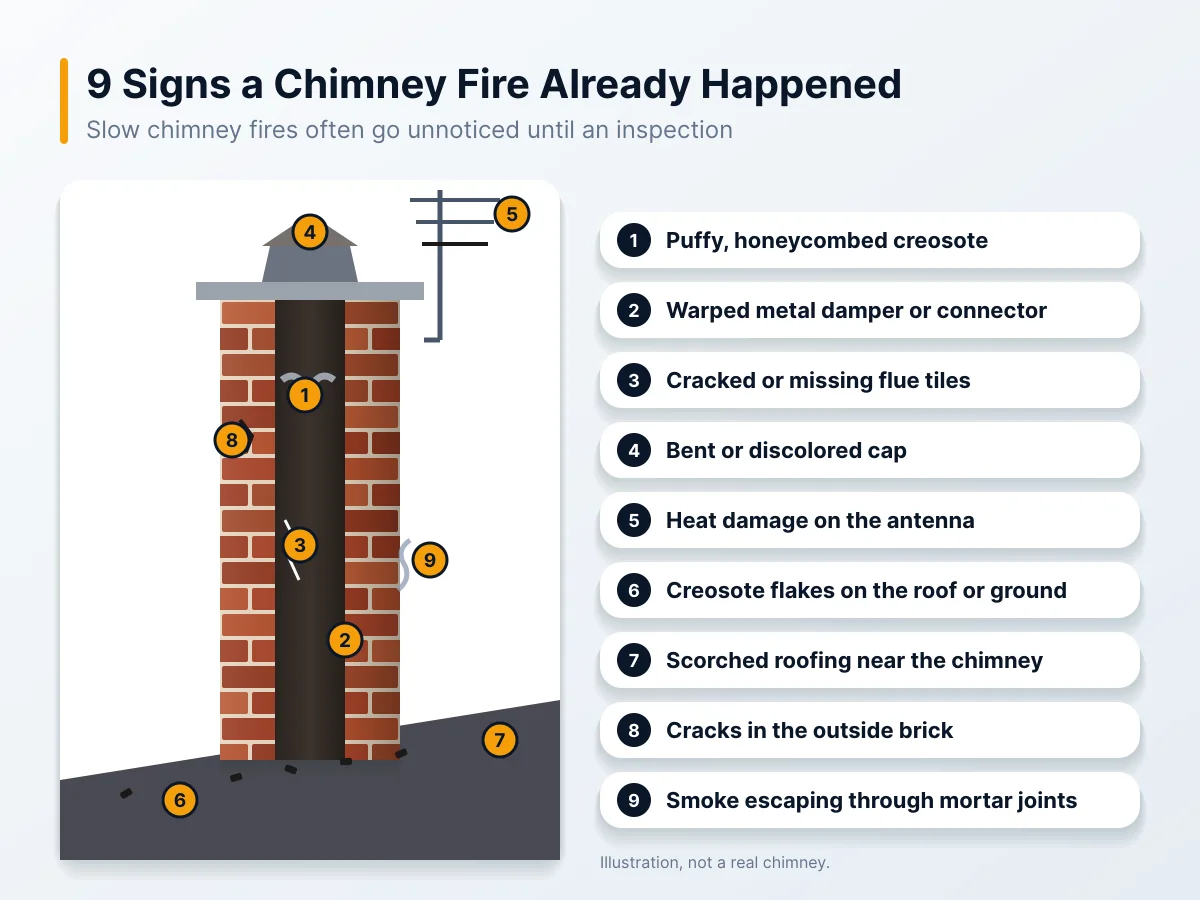
- Puffy, honeycombed creosote. Burned creosote swells and looks like a gray or black sponge stuck to the flue walls.
- A warped damper or connector pipe. Metal that has been through a fire can bend, buckle or no longer close tight.
- Cracked or missing flue tiles. Pieces of clay tile in the firebox or on the smoke shelf are a strong warning sign.
- A bent or discolored chimney cap. Heat can turn the metal blue, brown or rainbow colored and warp the mesh.
- Heat damage on the TV antenna. An old antenna strapped to the chimney may be bent or scorched near the top.
- Creosote flakes on the roof or ground. Small black flakes on shingles, the lawn or a deck near the chimney are often blown out during a fire.
- Scorched roofing next to the chimney. Look for melted or discolored shingles around the chimney base.
- Cracks in the outside brick. New cracks in the masonry, especially near the top of the stack, can come from rapid heating.
- Smoke escaping through the mortar joints. If smoke seeps through the brick or into the attic when you burn, the flue is no longer sealed.
Most of these clues are hard to judge from the ground. A sweep with a flue camera can tell the difference between normal wear and fire damage, and can show you the photos.
Why Do You Need a Level 2 Inspection After a Fire?
The CSIA lists three levels of chimney inspection. It says a Level 2 inspection is required after a chimney fire, after a malfunction, or after an outside event such as a storm or earthquake that could have damaged the chimney. It is also needed when you sell a home or change the fuel or appliance the chimney serves.
| Inspection level | When it is used | What it covers |
|---|---|---|
| Level 1 | Yearly check of a chimney with no changes and no known problems | The parts you can reach and see: firebox, damper, flue opening and basic clearances |
| Level 2 | After a chimney fire, storm damage, a home sale or a change of appliance | Everything in Level 1 plus a camera scan of the full flue and checks in the attic, basement and crawl space |
| Level 3 | When a Level 2 finds signs of hidden damage that cannot be reached | Opening up parts of the chimney or the walls around it to see the damage directly |
A Level 1 check only looks at the parts you can see. Fire damage tends to sit in the middle of the flue, where tiles take the most heat and where a flashlight cannot reach. That is why the camera scan matters.
This is especially true in Annapolis. Many brick chimneys in the Historic District, Eastport and Murray Hill were built long before modern liners, and some still have the original clay tiles or no liner at all. Wood framing in older homes can also sit closer to the chimney than current codes allow, so a crack in the flue is a bigger risk.
What Damage Can a Chimney Fire Cause?
The CSIA says a chimney fire can reach temperatures near 2,000 degrees Fahrenheit. In a masonry chimney, that heat can melt mortar, crack tiles, make the liner collapse and damage the outer brick. In a factory built fireplace with a metal flue, the metal can warp and the seams can split.
| Part of the chimney | What the heat does | Typical fix |
|---|---|---|
| Clay flue tiles | Crack, split or fall into the chimney | A new stainless steel or cast in place liner |
| Mortar joints | Burn out and leave gaps between tiles or bricks | Repointing or rebuilding the damaged section |
| Damper and smoke chamber | Warp, rust or stop sealing | A new damper and a smooth parged smoke chamber |
| Chimney cap and crown | Warp, discolor or crack | A new cap and a crown repair |
| Factory built metal flue | Buckle, warp or split at the seams | Replacement parts approved by the maker |
| Wood framing next to the chimney | Chars where it touches hot masonry | Carpentry repair after the chimney is fixed |
A damaged liner is the most common repair after a fire, because the liner is what keeps heat and gases inside the flue. Our page on chimney liner repair in Annapolis explains the liner options, and our chimney repair service covers the brick, crown and mortar work.
Does Homeowners Insurance Cover a Chimney Fire?
Often, yes. A standard homeowners policy usually covers sudden fire damage, including a chimney fire. Policies usually do not cover damage caused by age, wear and tear or neglect, and an insurer may question a claim if the fire came from years of creosote buildup with no cleaning on record. Every policy is different, so read yours or ask your agent.
These records make a claim easier to support:
- Dated photos of the damage taken before any cleanup
- The written Level 2 inspection report with camera images
- Receipts or reports from past chimney sweeps and inspections
- The fire department incident number, if crews came to the house
- A written repair estimate from a licensed contractor
Keep every report from your yearly sweep. A clean history is the best proof that the chimney was cared for before the fire.
Who Can Repair a Chimney in Maryland?
Maryland does not license chimney sweeps, and the Maryland Home Improvement Commission says that cleaning a chimney is not home improvement. Repairs are different. The same agency says building or reinforcing a chimney, or installing a chimney cap, is home improvement work that needs an MHIC license.
Before you sign a repair contract, ask for the MHIC license number and check it on the Maryland Department of Labor website. Ask for a written estimate that lists each repair, the materials and the photos that show why the work is needed.
How Common Are Chimney Fires?
More common than most people think. The U.S. Fire Administration reported that from 2017 to 2019 there were about 34,200 residential building heating fires each year in the United States. Most of them, 77 percent, were small fires confined to the chimney, the flue or the fuel burner.
| USFA finding, 2017 to 2019 | Yearly average |
|---|---|
| Residential building heating fires | About 34,200 |
| Share confined to the chimney, flue or fuel burner | 77 percent |
| Deaths | 165 |
| Injuries | 600 |
| Property loss | $367 million |
| Peak month | January, with 20 percent of these fires |
Here in Anne Arundel County, the first cold nights in late fall are when many fireplaces are lit for the first time in months. A flue that picked up a bird nest, leaves or damp creosote over the humid Chesapeake summer is at its riskiest on that first fire.
How Do You Prevent Another Chimney Fire?
- Sweep before buildup gets thick. The CSIA says a masonry chimney should be swept when sooty buildup reaches 1/8 inch, or sooner if there is glaze.
- Burn only dry, seasoned wood. The EPA says firewood should have a moisture content below 20 percent. Softwood needs at least six months to dry and hardwood at least a year.
- Never burn trash. The EPA warns against burning garbage, plastics, cardboard with color print and painted or treated wood.
- Give the fire enough air. Open the damper fully and avoid long, smoldering fires that cool the flue and leave more creosote.
- Fit a chimney cap. A cap with mesh keeps out leaves, nests and rain that can block the flue or speed up damage.
- Keep alarms working. Test smoke alarms and carbon monoxide alarms every month and put one on every level of the home.
- Get a yearly inspection. The national chimney standard, NFPA 211, calls for chimneys, fireplaces and vents to be inspected at least once a year.
Frequently Asked Questions
Can you use a fireplace after a chimney fire?
Not until it has been inspected. The CSIA calls for a Level 2 inspection after a chimney fire, which includes a camera scan of the whole flue. Burning again with a cracked liner can let heat reach the wood framing around the chimney.
Can a chimney fire go out on its own?
Yes, many do, which is why slow fires often go unnoticed. A fire that burns out can still crack tiles, warp metal parts and leave gaps that put the next fire closer to the house.
Does a chimney always need a new liner after a fire?
No. Some fires leave only light damage that can be cleaned or patched. If the camera shows cracked, shifted or missing tiles, a new liner is usually the safest fix.
What should I give my insurance adjuster?
Dated photos, the written Level 2 inspection report with camera images, past sweep receipts, the fire department incident number and a written estimate from a licensed contractor.
The Bottom Line
Chimney fire damage can be serious even when the fire seemed small or went out on its own. Stop using the fireplace, take photos, call your insurer and book a Level 2 inspection before the next fire. Repairs in Maryland should be done by a contractor with an MHIC license.
If you think your chimney had a fire, call Annapolis Chimney Pros at (667) 301-7778 or request an inspection online. We are open 24/7, and we will scan the flue and show you every photo before we recommend a repair.
Sources: Chimney Safety Institute of America pages on chimney fires and inspection levels, U.S. Fire Administration report on heating fires in residential buildings (2017 to 2019), Maryland Home Improvement Commission FAQ, EPA Burn Wise guidance on firewood, NFPA 211, and Policygenius on homeowners insurance and chimney fires.