
Leak Repair, Flashing and Water Repellent · Annapolis and Anne Arundel County
Chimney Waterproofing Annapolis
Stop Leaks at the Source
Water on the damper after a storm? Stains on the ceiling by the fireplace? We find where the water gets in, fix it, then seal the brick with a product that lets it breathe.
The Basics
More Than a Coat of Sealer
Chimney waterproofing in Annapolis is about more than spraying a sealer on brick. A chimney stands above the roof on all four sides, so it takes the full force of every rainstorm and nor’easter that rolls in off the Chesapeake Bay. When water gets in, it shows up as a drip in the firebox, a brown stain on the ceiling or white powder on the brick outside.
Most homeowners call us after the damage is visible. By then the question is not just how to seal the chimney. It is where the water is getting in, how much harm it has done and what will actually stop it.
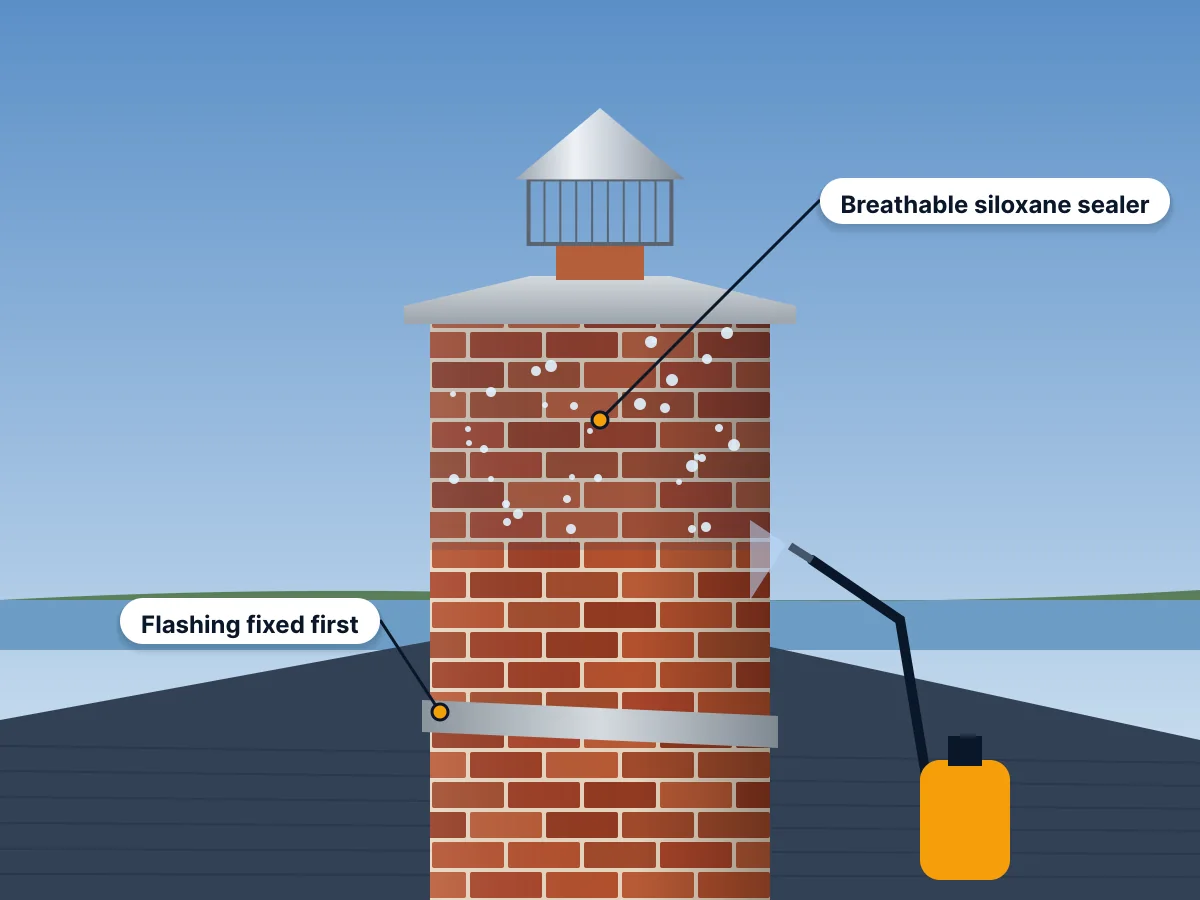
That is why every job starts with finding the leak. A sealer cannot fix bad flashing, a cracked crown or a missing cap. We fix the real entry point first, then protect the brick with a breathable water repellent so the next storm runs off instead of soaking in.
Rain and Your Chimney
Why Chimneys Leak in Annapolis
Is It Normal for a Chimney to Leak When It Rains?
No. A sound chimney with a good cap, crown and flashing should stay dry inside, even in a hard rain. A leak means water has found a way in, and it will keep using that path until it is fixed. The only common exception is condensation: a gas appliance venting into a large, cold flue can leave water on the damper even on dry days, which points to a liner problem instead of rain.

What Happens When Rain Gets Into a Chimney?
Water does slow, quiet damage that gets more expensive the longer it runs.
- Brick and mortar break down. Wet masonry that freezes on a cold night expands, then thaws. Each cycle pushes joints and brick faces apart, and pieces start to flake off (spalling).
- Metal rusts. Dampers, firebox parts, caps and chase covers corrode and stop working.
- Wood rots. Rafters, sheathing and framing next to the chimney stay wet and start to rot. This is often found only when a ceiling stain appears.
- Mold and odor. Damp creosote in the flue gives off a strong, musty smell, worse in humid summer weather.
- The liner suffers. Water running down the flue cracks clay tiles and eats mortar joints, which can lead to chimney liner repair.
Why Are Annapolis Chimneys So Exposed?
Three things work against chimneys here. Damp air off the Chesapeake Bay, the Severn River and Spa Creek keeps brick wet longer after each storm. Nor’easters drive rain sideways into the face of the chimney, not just onto the top. And many homes in the Historic District, Eastport and Murray Hill have older, softer brick and lime mortar that soak up water faster than modern masonry.
Diagnosis
Find the Leak First: Where Water Gets Into a Chimney
A chimney leak almost always comes through one of a few weak spots. Where you see the water tells us where to look first.

| What You See | Most Likely Entry Point | Usual Fix |
|---|---|---|
| Water dripping onto the damper or into the firebox | Missing or damaged cap, or a cracked crown | New chimney cap or crown repair |
| Stain on the ceiling or wall right next to the chimney | Failed flashing where the roof meets the chimney | Flashing repair or flashing replacement |
| Leak only during wind driven rain | Porous brick or open mortar joints on the windward side | Repointing, then a water repellent |
| White powder (efflorescence) on the outside brick | Water moving through the masonry and leaving salts behind | Fix the water source, then seal |
| Flaking brick faces (spalling) | Water freezing inside the brick | Replace damaged brick, then seal |
| Puddle on the uphill side of a wide chimney | No cricket to split water around the chimney | Add a cricket with new flashing |
| Damp damper on dry days with a gas appliance | Condensation in an oversized flue | Liner sized to the appliance |

What Can I Use to Seal Around a Chimney?
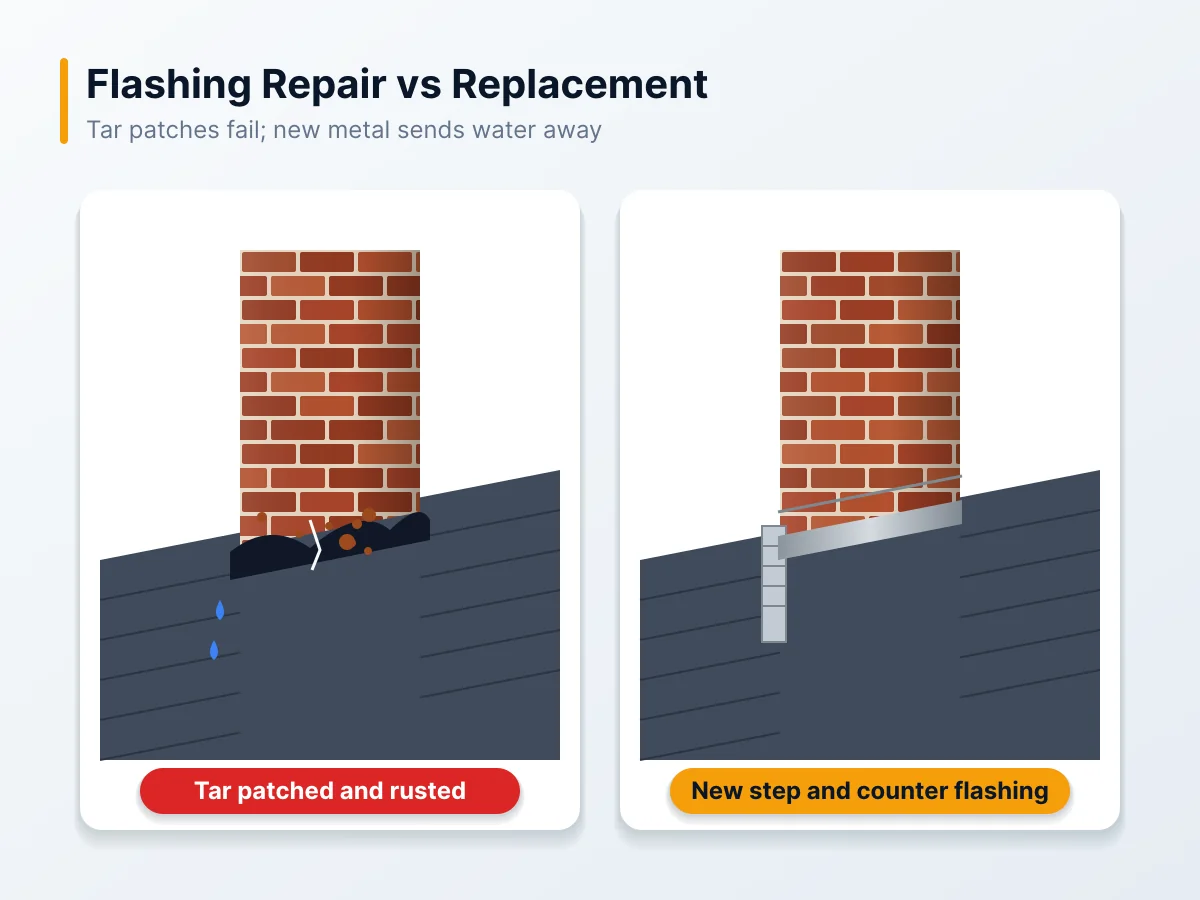
The joint between the roof and the chimney is sealed by metal flashing, not by caulk or roofing tar alone. Proper flashing has two parts: step flashing woven into the shingles and counter flashing set into the mortar joints that laps over it. Caulk and tar crack and pull away within a few seasons, so they are a short term patch at best.
What Is a Chimney Cricket, and Do I Need One?
A cricket (also called a saddle) is a small peaked roof built on the uphill side of the chimney. It splits rain and leaves so they flow around the chimney instead of piling up behind it. The International Residential Code, section R1003.20, requires a cricket when the side of the chimney facing the ridge is wider than 30 inches and the chimney does not sit on the ridgeline. Older chimneys built before this rule may not have one.
Waterproofing Services
Our Chimney Waterproofing Services in Annapolis, MD
We treat waterproofing as a full system: find the entry point, repair it, then protect the masonry. Here is what each service covers.
Chimney Inspection
Every waterproofing job starts with a chimney inspection. We check the cap, crown, flashing, brick, mortar joints and the inside of the flue, and we photograph what we find. If the leak path is hidden, a Level 2 inspection with a camera shows water damage inside the flue that you cannot see from the roof. You get a clear answer on where the water is coming from before you spend money on a fix. Best for: any new leak, a home purchase, or stains you cannot trace.
01
Chimney Leak Repair
Chimney leak repair fixes the specific spot letting water in. That can mean repointing open mortar joints, replacing cracked or spalled brick, sealing the gap around the flue tile, or repairing a cracked crown. Fixing the real entry point is what stops the drip. A sealer alone will not. Best forActive leaks, crumbling joints, cracked crowns.
02
Flashing Repair
Flashing repair fixes metal flashing that is mostly sound but has failed in spots. We reseal loose counter flashing, replace short sections, refasten pieces that have pulled away and clean out old tar patches that trap water. This is the right call when the metal is in good shape and only the seal has failed. Best forA small leak at one side of the chimney, loose or lifted flashing.
03
Flashing Replacement
Flashing replacement is for flashing that is rusted through, buried under layers of tar, or was never installed right. We remove the old metal, install new step flashing woven into the shingles and new counter flashing cut into the mortar joints, and add a cricket where the chimney is wide enough to need one. A new roof is the best time to do this, so the flashing and shingles are installed together. Best forRusted or tar covered flashing, repeat leaks, a new roof, a missing cricket.
04
Water Repellent
Once the leak is fixed, we apply a penetrating, vapor permeable water repellent to the brick and mortar. It soaks into the masonry and makes water bead off the surface while still letting moisture inside the brick escape as vapor. The Brick Industry Association names chimneys as one of the places where a repellent is most useful and recommends siloxane based products. Best forExposed chimneys, older porous brick, chimneys that face driving rain.
Products Compared
Breathable Water Repellent vs Flex Seal, Paint and Caulk
The product you put on brick matters as much as the leak repair. Brick has to breathe. Water vapor from inside the chimney and the house moves out through the masonry, and anything that traps it can make damage worse. This table uses the durability figures from Brick Industry Association Technical Note 6A.

| Product Type | How It Works | Lets Brick Breathe? | Typical Life | Our View for Chimneys |
|---|---|---|---|---|
| Siloxane or silane water repellent | Soaks into brick and mortar, beads water off | Yes | 10 years or more | The right choice after repairs |
| Acrylic sealer | Forms a clear film on the surface | Partly | 5 to 7 years | Can trap moisture; not our pick |
| Silicone resin sealer | Thin surface coating | Partly | About 1 year | Wears off fast |
| Rubber coating such as Flex Seal | Thick film that covers the surface | No | Varies | Traps water in the brick; temporary at best |
| Paint or masonry paint | Opaque film | Usually not | Varies | Can peel and trap moisture behind it |
| Caulk or roofing tar | Fills one gap | No | A few seasons | Short term patch, not a fix |
What Is the Downside of Flex Seal on a Chimney?
Flex Seal and similar rubber coatings form a skin over the brick. Rain stays out for a while, but moisture already inside the brick, and vapor coming up from the flue, cannot get out. That trapped water freezes and thaws in winter, which can push the brick face off from behind. The coating also hides cracks, so the real problem keeps growing where you cannot see it, and it has to be scraped off before a proper repair. Use it only as a stopgap until a pro can look at the chimney. For Flex Seal on the crown itself, see our chimney crown repair page.
How Do You Seal Cracks in a Chimney?
It depends on where the crack is and how wide it is.
- Cracks in mortar joints: grind out the old mortar and repoint with new mortar matched to the brick. Older homes with soft brick need a softer, lime based mortar so the joint is weaker than the brick, not stronger.
- Cracks in the crown: hairline cracks can be sealed with a flexible crown coating; wider cracks mean crown repair or replacement.
- Cracked or spalled bricks: replace the damaged bricks.
- Fine surface cracks after repairs: a siloxane water repellent helps here, but only on very small gaps. The Brick Industry Association notes that repellents cannot stop water in cracks wider than 0.02 inch, about half a millimeter.
Honest Advice
Is Chimney Waterproofing Worth It?
For most Annapolis chimneys, yes, as long as it is done in the right order. A water repellent is a low cost layer of protection that keeps brick drier for years. It is not a cure for a leak that comes through flashing, a crown or wide cracks. Here is an honest guide.
| Your Situation | Is a Water Repellent Worth It? |
|---|---|
| Older, porous brick that darkens and soaks up rain | Yes, after any repairs |
| Chimney on the windward side or near the water | Yes, it takes the most driving rain |
| Just repointed or rebuilt chimney | Yes, once the new mortar has cured |
| Active leak at the roof line | Not yet; fix the flashing first |
| Cracked crown or missing cap | Not yet; fix those first |
| Heavy efflorescence on the brick | Not yet; find and stop the water source first |
| Brand new masonry | Wait at least a month, ideally a year, so salts can come out first |
Is Sealing a Chimney a Good Idea?
Sealing is a good idea when the product is breathable and the chimney is already in good repair. It is a bad idea when a film forming coating is used, or when it is used to cover up cracks and bad flashing. The wrong product, or the right product used too early, can trap water and salts inside the brick.
How Long Does Chimney Waterproofing Last?
The Brick Industry Association lists siloxane and silane repellents at 10 years or more. Most coatings need to be reapplied every 5 to 15 years, depending on exposure. Putting a new coat on too soon can reduce how well the brick breathes, so we check the old coat before recommending another.
What Is the Average Lifespan of a Chimney?
There is no single number. A well built masonry chimney that stays dry can last for many decades. Water is what shortens that life, through freeze and thaw damage, rusted metal parts and crumbling mortar. Keeping a chimney dry, with a sound cap, crown and flashing and a breathable repellent, is the most direct way to make it last.
Pricing
How Much Does Chimney Waterproofing Cost in Annapolis, MD?
The price depends on what is letting water in. Sealing brick that is already in good shape is the smallest job. Flashing and crown work cost more, and rot repair after a long running leak costs the most. These are national ranges, so use them as a guide; your written quote after the inspection is the real number.
What Changes the Price?
- Chimney size and height. A tall chimney on a two or three story home needs more product and more time on the roof.
- Roof pitch and material. Steep or slate roofs need extra safety gear and care.
- Repairs needed first. Repointing, brick replacement or a new cricket add to the total.
- Hidden damage. Rot in the roof deck or framing next to the chimney is only priced once it is opened up.
The cheapest leak is the one fixed early. A few hundred dollars for flashing or sealing is far less than replacing rotted framing and a stained ceiling later.
Are Chimney Leaks Covered by Homeowners Insurance?
It depends on your policy and the cause. Damage from a sudden event, such as a tree limb hitting the chimney or a storm tearing off flashing, is more likely to be covered. Leaks from slow wear, old mortar or flashing that failed over time are often treated as maintenance and denied. Cracks follow the same pattern. Our dated photos and written report can help if you file a claim, but check the details with your insurer.
Typical Waterproofing Prices
| Job | National Range |
|---|---|
| Waterproofing or sealing the chimney | $150 to $500 |
| Chimney leak repair | $150 to $500 |
| Flashing repair | $200 to $300 |
| Flashing replacement | $300 to $800 |
| Crown repair | $750 to $1,000 |
| Wood rot repair after a leak | $100 to $300 small areas, $2,500 to $4,000 large areas |
National ranges from Fixr (updated January 2025) and Bob Vila (rot repair). Not Annapolis quotes.
Step by Step
Our Chimney Waterproofing Process, Step by Step
Here is what happens from the first look at your chimney to the final photos.
Step 1
Inspect
We check the cap, crown, flashing, brick, mortar and flue, and photograph every problem we find.
Step 2
Plan and Price
You get a written plan that lists the leak source, the repair and the sealing step, with a price before work starts.
Step 3
Protect
We cover plants, decks and gutters below the chimney and protect the roof around it.
Step 4
Repair the Entry Point
Flashing, crown, cap, mortar joints or bricks are fixed first, since a sealer cannot close those gaps.
Step 5
Clean
Dirt, moss, algae and loose material come off so the repellent can soak in.
Step 6
Let It Dry
Masonry must be dry before sealing. New mortar needs time to cure, so sealing sometimes happens on a second visit.
Step 7
Apply the Water Repellent
A breathable siloxane product goes on evenly, top to bottom, following the maker’s label for coverage and temperature.
Step 8
Show You the Results
Before and after photos go into your report, along with when the chimney should be checked again.
When Is the Best Time to Waterproof a Chimney in Annapolis?
Any stretch of dry weather with temperatures inside the product’s label range works, which in Annapolis usually means spring through fall. The brick needs to be dry, and no rain should be expected for the curing time on the label. Winter work is possible on mild, dry days, but cold, wet weeks are not a good time to seal. Leaks themselves should be fixed as soon as they are found, in any season.
Local Service
Chimney Waterproofing Annapolis MD: Local Neighborhoods and Conditions
We work out of 839 Bestgate Rd, just off Route 50 near Annapolis Mall, and serve homes across the city and the rest of Anne Arundel County. Where your home sits changes how hard the weather hits your chimney.
- Eastport
- Bay Ridge
- Hillsmere
- Historic District
- Murray Hill
- West Annapolis
- Admiral Heights
- Annapolis Roads
- Wardour
- Parole
| Area | What the Chimney Is Up Against |
|---|---|
| Eastport, Bay Ridge and Hillsmere | Open water exposure, wind driven rain and salt air that wears on flashing and caps |
| Historic District near the State House, City Dock and St. John’s College | Soft historic brick and lime mortar that need breathable products; visible changes may need Historic Preservation Commission review |
| Murray Hill and West Annapolis, near the Naval Academy | Older chimneys with original flashing and worn mortar joints |
| Admiral Heights, Annapolis Roads and Wardour | Chimneys facing the Severn River or the bay that take storms head on |
| Parole and the Forest Dr corridor near Annapolis High School | Roof replacements that are the right time to redo flashing |
| Arnold near Anne Arundel Community College, Severna Park, Cape St. Claire and Edgewater | Tree cover that holds moisture and drops debris behind chimneys |
Do Historic Annapolis Homes Need Special Care?
Yes. Older brick is softer and more absorbent than modern brick, and the original lime mortar is meant to be the weak point that wears first. Hard modern mortar or a film forming coating can force moisture to escape through the brick instead, which damages the face. We use breathable repellents and matched mortar on older homes, and we plan any visible exterior change, such as new flashing or a cap, with the City of Annapolis Historic Preservation Commission rules in mind.
We also waterproof chimneys in nearby towns, including Arnold, Severna Park, Crofton, Pasadena, Parole, Crownsville, Odenton and Edgewater. If you are booking a chimney sweep in Annapolis, ask us to check the masonry for water damage at the same visit.
FAQs
Frequently Asked Questions
How much does it cost to fix a chimney leak?
By national figures, most leak repairs and sealing jobs run $150 to $500, flashing repair about $200 to $300 and flashing replacement $300 to $800. Crown work and rot repair cost more. We price your job in writing after finding the leak.
Can I waterproof my chimney myself?
You can buy siloxane repellents, but the hard part is not the spraying. It is finding the real leak, fixing flashing or mortar first and working safely on the roof. Sealing over an unfixed leak, or using a film forming product, can trap water and make the damage worse.
Will a water repellent change the look of my brick?
Penetrating siloxane repellents soak in and usually dry clear, so most brick looks about the same. Some brick can darken slightly, so we test a small area first on older or historic homes.
How long does chimney waterproofing take?
Sealing a chimney that is already in good repair is usually done in one visit once the brick is dry. Flashing replacement, repointing or crown work can add a day, and new mortar needs to cure before it is sealed.
Does waterproofing stop efflorescence?
It helps once the water source is fixed, because less water moving through the brick means fewer salts left on the surface. Sealing over active efflorescence can trap salts under the surface, so the leak has to be stopped first.
Can a roofer fix a chimney leak?
A roofer is the right call when the leak is in the shingles around the chimney. If water comes through the cap, crown, brick or mortar, you need masonry work. Many leaks involve both, so have the whole chimney checked, not just the flashing.
Should the inside of the chimney be waterproofed?
No. Water repellent goes on the outside brick. The inside is protected by a cap that keeps rain out and a liner that handles heat and moisture from the fire or appliance.
What cement should be used for a chimney crown?
A crown should be cast with concrete or a crown repair mix made for the job, not plain mortar, which cracks quickly. See our chimney crown repair page for crown building details.
How often should a chimney be inspected for leaks?
Once a year. NFPA 211 calls for a yearly chimney inspection, and checking for water damage is part of it.
Related services: chimney inspection, chimney repair, chimney cap installation, chimney crown repair and chimney liner repair, or contact us.
Keep Your Chimney Dry This Season
Every storm that soaks an unprotected chimney does a little more damage to the brick, the flashing and the wood around it. The fix is simple when it is done in the right order: find the leak, repair it, then seal the masonry with a breathable repellent. For honest chimney waterproofing in Annapolis, call us for an inspection, clear photos and a written price before any work starts.
Annapolis Chimney Pros
839 Bestgate Rd #100, Annapolis, MD 21401
Phone: (667) 301-7778
Sources: Brick Industry Association, Technical Note 6A, Fixr chimney repair cost guide (January 2025), Bob Vila chimney repair cost and NFPA 211.